When introducing a new business idea or AI-driven innovation, a Proof of Concept (POC) plays a critical role in validating feasibility, demonstrating value, and gaining customer and investor confidence. AI-focused POCs establish how advanced technologies—such as Machine Learning (ML), Generative AI, Retrieval-Augmented Generation (RAG), Agentic AI, and Oracle Fusion AI capabilities can effectively address real business needs and deliver meaningful outcomes for end users.
POCs also provide organizations with an early opportunity to gather stakeholder feedback while minimizing risk and investment. By validating AI models, data strategies, Oracle AI integrations, and architectural decisions early in the development lifecycle, businesses can assess ideas, refine designs, and make informed decisions before scaling to enterprise-wide implementation.
TATCODE delivers an innovative AI POC-as-a-Service model, enabling customers to rapidly build MVPs (Minimum Viable Products) powered by Oracle AI, Fusion AI, and advanced AI frameworks. Our diversified and future-ready technology stack allows organizations to quickly test AI-driven innovations in real-world scenarios, accelerate adoption, and focus on business innovation—while we manage the underlying technology, architecture, and execution.
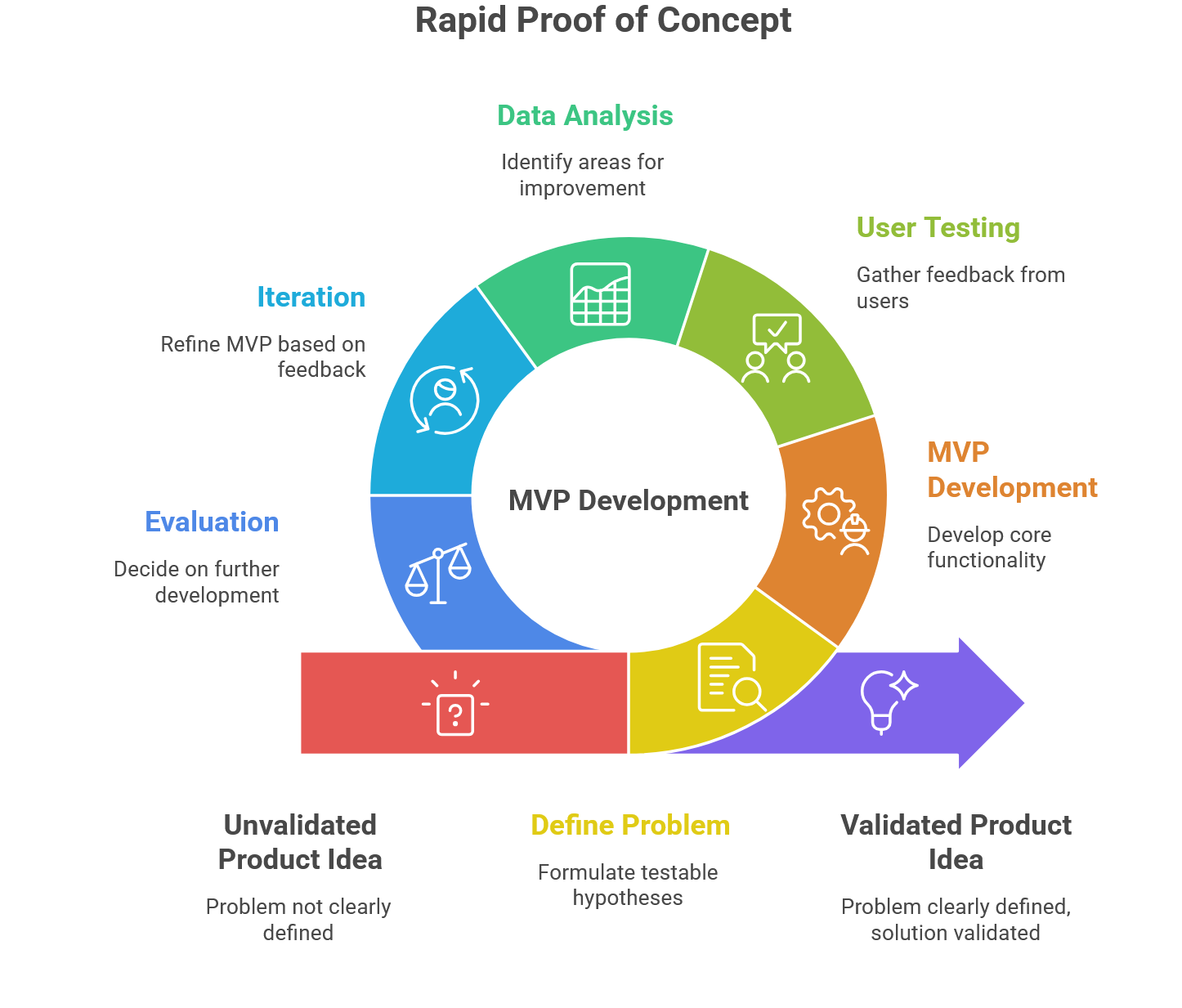

1. Problem Identification & Ideation
Identify a real customer problem and propose a high-level solution hypothesis.
2. Market & Idea Validation
Validate market demand, target users, and willingness to adopt or pay for the solution.
3. POC Definition & Design
Define the minimal technical scope required to prove feasibility and reduce key risks.
4. Build Proof of Concept (POC)
Develop a limited prototype to demonstrate technical viability of the core idea.
5. POC Validation & Iteration
Evaluate POC results, validate assumptions, and iterate or pivot based on learnings.
6. MVP Definition (Product Scope)
Define the smallest set of features that delivers core user value in a usable product.
7. Build MVP
Build a production-ready version of the product with essential features for real users.
8. Market Fit Analysis (Product-Market Fit)
Measure user adoption, engagement, retention, and feedback to assess product relevance.
9. Validate & Iterate (POC + MVP loops)
Continuously refine the solution through rapid feedback-driven iterations.
10. MVP Build → PMF Loop
Iterate MVP releases until strong and repeatable product-market fit is achieved.
11. Build Scalable & Secure Application
Evolve the product architecture to support scale, performance, security, and reliability.
12. Growth & Expansion
Scale user adoption, expand markets, and optimize monetization and feature breadth.